



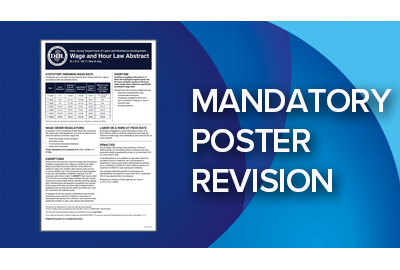
The State of New Jersey has released its revised labor law poster, which informs employees of the 2026 New Jersey minimum wage. Specifically, the New Jersey Department of Labor and Workforce Development revised its Wage and Hour Law Abstract poster to reflect a minimum wage increase from $15.49 per hour to $15.92 per hour. The wage increase will take effect on January 1st, 2026.
Why Did the New Jersey Minimum Wage Increase?
Under state law (N.J.S.A. 34:11-56a et seq.), New Jersey is one of several U.S. states that adjusts its minimum wage rate annually to reflect inflation. The forty-three-cent increase on January 1st, 2026, will have resulted from changes to the Consumer Price Index. It is important to note, however, that the Department of Labor and Workforce Development states that certain workers and occupations are exempt from the minimum wage requirement. These occupations include automobile salespersons, outside salespersons, and minors under the age of 18 who do not work in retail, food service, the first processing of farm products, beauty culture occupations, laundry, cleaning and dyeing occupations, light manufacturing and apparel occupations, and hotel and motel occupations.
While the increased rate of $15.92 per hour applies to most employees in New Jersey, current state law allows lower hourly wage rates for certain types of businesses and workers. Seasonal and smaller employers with fewer than six employees must pay employees at least $15.23 per hour in 2026, while agricultural employers must pay at least $14.20 per hour. Long-term facility direct care workers in New Jersey must receive a higher minimum wage, totaling at least $18.92 per hour worked beginning January 1st, 2026.
What is the Required New Jersey Tipped Employee Minimum Wage Rate Starting in 2026?
As of July 1st, 2019, tipped workers in New Jersey must earn a minimum wage that adjusts each year. Tipped employees in New Jersey must earn a cash wage of at least $6.05 per hour in 2026. Under state law, a tipped employee regularly receives at least $30 in tips per month, excluding service charges. If the employee's allocated tips do not result in an hourly total compensation rate equal to the 2026 minimum wage rate, employers must make up the difference.
Under New Jersey law, an employer can apply up to a set maximum amount of an employee’s tips towards their minimum wage obligation. This is called taking a tip credit. Tips, however, solely belong to the employee, and employers may not take or deduct any portion of an employee's tips if they wish to use the tip credit. In 2026, the maximum tip credit is $9.87 per hour. Deducting from an employee's earned tips without a bona fide tip pooling arrangement violates New Jersey's Wage Payment Law and minimum wage regulations.
Employer Takeaways
New Jersey employers must immediately post the revised 2026 Wage and Hour Law Abstract poster to notify affected workers of the increased minimum wage rates. Additionally, employers who previously paid non-tipped and tipped employees at rates below the new 2026 state minimums must adjust employee compensation accordingly.
Labor Law Posters Online's revised 2026 New Jersey State & Federal Labor Law Poster now includes the recently released Wage and Hour Law Abstract. Our all-on-one compliance solution is guaranteed to include all recent updates to any required state and federal posters. Existing Labor Law Posters Online customers who purchased an annual poster subscription plan will receive the revised notice at no additional cost as part of their automatic poster update service.