


For any business owner or HR director in Idaho, 2026 brings a mix of stability and quiet risk, which makes displaying the current Idaho labor law posters more important than ever. Neighboring states like Washington and Oregon have pushed through steep minimum wage increases and complex paid leave laws, while Idaho continues to operate under federal standards, keeping it a business-friendly state built on flexibility.
A few significant updates did take effect in Idaho in 2026, including a 2.5% reduction in workers' compensation rates that offers financial relief. Even so, strict enforcement around employee classification and child labor hours remains a real risk area, so compliance still starts with the correct posters displayed in the workplace. This guide walks through the legal framework you must follow, helping you run your business efficiently and avoid legal penalties.
Idaho Labor Laws 2026: Wages and Overtime
Idaho sets its minimum wage at the federal rate of $7.25 per hour, and employers must pay employees at least this amount. Employers subject to the Fair Labor Standards Act (FLSA) must also comply with federal minimum wage and overtime requirements. Displaying the current Idaho minimum wage poster is one of the simplest ways to keep employees informed about these requirements and stay compliant.
Tipped Employees Under Idaho Labor Laws
Under Idaho's wage law, tipped employees may be paid a lower cash wage of $3.35 per hour. However, a tipped employee's hourly cash wages and earned tips must add up to at least the state-mandated minimum wage of $7.25 per hour. If a slow shift means their tips do not bridge that gap, the employer must make up the difference.
Exceptions
New hires under the age of 20 can be paid a training wage of $4.25 per hour for their first 90 days of employment. Employers cannot displace existing workers to hire new ones at this lower rate.
Who Is Protected by Idaho Labor Laws?
Idaho labor laws protect many workers, but the protections are not as extensive as those provided by the federal government. It is also important to know that most of Idaho's employment laws only protect employees, not independent contractors.
This distinction is the most common trap for employers in 2026. If you control the means and manner of the work, dictating hours, providing tools, and supervising the process, the worker is likely an employee. Misclassifying them as contractors to save on payroll taxes is dangerous. State agencies increasingly share data, so a discrepancy in your unemployment filings can trigger a broader audit.
Workers' Compensation: What Do Idaho Labor Laws Require?
Employers with one or more full-time, part-time, seasonal, or occasional employees must carry workers' compensation coverage under the Idaho Workers' Compensation Law. An employer must obtain this coverage before the first employee is hired.
The Idaho Department of Insurance has approved a National Council on Compensation Insurance (NCCI) filing that reduces workers' compensation insurance rates by approximately 2.5% beginning January 1, 2026. This continues a trend toward lower employer costs driven by reductions in claim frequency, but it does not mean enforcement is relaxed.
If an employee is injured while working for an employer who does not carry workers' compensation insurance at the time of injury, Idaho labor laws hold the uninsured employer completely liable for all costs associated with the benefits and health care for that injured employee, including compensation for lost wages from the time of injury until the employee returns to work after receiving all necessary medical treatment.
In addition, the uninsured employer may be assessed a penalty equal to 10% of the wage loss and medical benefits owed under workers' compensation law for the duration of the claim, and may also be liable for the injured worker's attorney fees to the extent the worker is represented by an attorney. An employer conducting business without coverage can also be fined $2.00 per day per employee, up to a maximum of $25.00 per day, whichever is greater.
Non-Compete Agreements: Are They Enforceable Under Idaho Labor Laws?
Under Idaho labor laws, non-compete agreements are only enforceable if the following criteria are met:
- The agreement does not impose a greater restraint on the employee than necessary.
- It protects a legitimate business interest, such as trade secrets or client relationships.
- It is reasonable in geographic scope; the area covered must be tied to the region where the business operates or where the employee had a direct impact.
- It applies only to key employees.
- It is reasonable in duration.
In Idaho, non-compete agreements typically cannot exceed 18 months unless exceptional circumstances apply. This 18-month presumption puts the burden of proof on the employer to justify any longer restriction.
Employees who may be subject to non-compete agreements include those with access to trade secrets or confidential information (key employees), those with commercial relationships or contacts with specific prospective or existing customers, vendors, patients, or clients, and those who have received specialized and unique training as described in a contract.
Leave Requirements: Do Idaho Labor Laws Mandate Paid Time Off?
Idaho has established very few leave laws to help employees attend to their own health, family obligations, and general well-being. The following is a quick overview of the current state leave requirements:
- Sick Leave: Not required. Idaho labor laws do not require employers to provide paid or unpaid sick leave. However, if an employer provides sick leave under a policy or contract, it must honor those benefits.
- Jury Leave: Employers may not terminate or discriminate against an employee called to serve on a jury. Jury leave is unpaid, and an employer who violates this law may incur a fine of $300.
- Military Leave: Public employees are entitled to a maximum of 15 days of annual paid military leave. Under federal USERRA law, private-sector employers must provide unpaid military leave and guarantee reemployment rights.
- Vacation Pay: Not required. If an employer provides vacation pay, the policy must be specific about whether an employee receives a payout for unused vacation at termination. If the policy is silent, Idaho courts have found that unpaid vacation time earns the status of wages due and payable.
Child Labor: Idaho Labor Laws for Minors
In Idaho, minors must be at least 14 years old to work in non-agricultural jobs.
Restrictions for 14 and 15-year-olds:
- When school is in session, minors aged 14 to 15 may work a maximum of 3 hours per day and 18 hours per school week.
- They may not work before 7:00 a.m. or after 7:00 p.m. when school is in session (extended to 9:00 p.m. from June 1 through Labor Day).
- When school is not in session, they may work up to 8 hours per day and 40 hours per week, and only between 7:00 a.m. and 9:00 p.m.
State law does not require work permits for minors employed in Idaho. However, employers are required to maintain accurate employment records for all minors aged 14 to 16.
What Are the Hiring and Termination Laws in Idaho?
Under the Idaho Human Rights Act, an employer with five or more employees cannot discriminate against employees based on race, color, sex, national origin, ethnic origin, age, disability, religion, or pregnancy.
Idaho is also a right-to-work state, meaning an employee cannot be required to join or pay dues to a labor union as a condition of employment. As an at-will state, Idaho allows employers to terminate employees for any reason, or no reason, at any time, unless a specific law or contract states otherwise. However, employers cannot fire employees for illegal reasons, such as discrimination or retaliation.
After a layoff or termination, an employee must receive their final paycheck within 10 business days (excluding weekends and holidays) or on the next regularly scheduled payday, whichever comes first. The process can be completed within 48 hours (excluding weekends and holidays) if the employee submits a written request.
Workplace Safety: Where Idaho Labor Laws Defer to OSHA
Idaho businesses must follow federal Occupational Safety and Health Administration (OSHA) standards, as required under the Occupational Safety and Health Act, which dictate safe and healthy working conditions to prevent worker injuries and illnesses.
Because Idaho labor laws do not include a state-approved OSHA plan for the private sector, federal inspectors have jurisdiction. For 2026, this means paying close attention to new federal emphasis programs on heat illness prevention and to electronic recordkeeping requirements for businesses with more than 100 employees.
Mandatory Posters: Idaho Labor Laws 2026
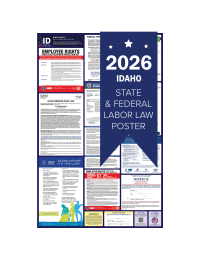
In Idaho, employers must display both the federal labor law poster and the Idaho labor law poster. These posters inform employees about their rights and protections and must be displayed in a common, accessible location such as a break room. If you also staff locations in other states, we carry sets like Texas labor law posters, California labor law posters, and Florida labor law posters.
Required State Postings:
- ID Unemployment Insurance
- ID Discrimination
- ID Minimum Wage
- ID Equal Opportunity is the Law
- ID Workers' Compensation Sample
Required Federal Postings:
- EEOC “Know Your Rights” Notice
- Fed-OSHA “It's the Law” Notice
- Federal Minimum Wage Notice
- Employee Polygraph Protection Notice
- Family and Medical Leave Act Notice
- USCIS Discrimination Notice
- USERRA Rights and Benefits Notice
- Payday Notice
- Employee “Right to Know” Notice
- IRS EITC / Notice 797 / W-4 Notice
For businesses managing remote teams or multiple locations, keeping physical posters current can be a challenge. Many employers use an annual workplace compliance subscription so that digital updates reach remote employees automatically, keeping the business compliant regardless of where the work happens.
Federal vs. State: Which Idaho Labor Laws Are Followed?
Employers in Idaho must follow both federal and state labor laws. If an Idaho labor law contradicts a federal law, the federal law takes precedence, unless the state law provides more protection or benefits to the employee. Important federal labor laws that Idaho employers should know include:
- Title VII of the 1964 Civil Rights Act: Prohibits discrimination in employment based on race, color, religion, sex (including pregnancy, sexual orientation, and gender identity), or national origin.
- The Age Discrimination in Employment Act (ADEA): Protects people over the age of 40 against discrimination in hiring, firing, and other terms and conditions of employment.
- The Americans with Disabilities Act (ADA): Makes it illegal to discriminate against people with disabilities in all areas of public life, including jobs, schools, and transportation.
- The Fair Labor Standards Act (FLSA): Sets federal minimum wage, overtime pay, recordkeeping, and youth employment requirements for private and public-sector employees.
- The Immigration Reform and Control Act (IRCA): Prohibits the employment of unauthorized workers by creating penalties for employers who knowingly hire them.
- The Family and Medical Leave Act (FMLA): Gives eligible employees of covered employers the right to unpaid, job-protected leave for specific family and medical reasons while continuing group health coverage.
- The Consolidated Omnibus Budget Reconciliation Act (COBRA): Gives workers and their families who lose health benefits the right to continue group health coverage for limited periods.
Not all federal laws apply to every workplace, so employers should confirm which apply to their business. Subscribing to labor law poster updates is an effective way to stay ahead of federal changes without constant manual monitoring.
Idaho Labor Laws 2026: Your Quick Compliance Checklist
With no significant new Idaho labor and employment laws in 2026, employers can use the following list to verify they are compliant with current requirements:
- Verify Classifications: Review all independent contractors to confirm they meet the strict right-to-control tests.
- Verify Wages: Confirm that all employees are paid at least the federal minimum wage of $7.25 per hour.
- Update Insurance: Confirm that your workers' compensation policy reflects the new lower 2026 rates.
- Check Posters: Make sure all state and federal posters in the break room are the most recently updated versions.
- Review Handbook: Clarify vacation payout policies to avoid unintended wages due at termination.
- Plan Ahead: Consider an annual workplace compliance plan to automate future poster updates.
FAQs
Is the minimum wage increasing in Idaho in 2026?
No. The minimum wage in Idaho remains at $7.25 per hour, matching the federal minimum wage. Several proposals to raise the rate were introduced this year, but none became law for 2026. Under state law, individual cities such as Boise cannot create a local minimum wage higher than the state rate. However, employers near the Washington or Oregon borders often pay above this rate voluntarily to stay competitive. To stay compliant, Idaho employers should display the current Idaho minimum wage poster, and businesses operating in multiple jurisdictions can review the available city and county labor law posters to confirm they have the correct postings for each worksite.
Are Idaho employers required to provide lunch breaks?
No. Idaho labor laws do not require employers to provide lunch breaks or rest periods to employees over 18 years of age. If a business gives an employee a break of less than 20 minutes, it must be paid. If the employee is free from work duties for 30 minutes or longer, the break may be unpaid.
Do I have to pay overtime in Idaho?
Yes. Under federal law, any hours worked over 40 in a single workweek must be compensated at 1.5 times the employee's regular rate of pay. Overtime is calculated based on the workweek, not the workday, so working a 12-hour shift does not trigger overtime unless the weekly total exceeds 40 hours.
Can I test employees for drugs in Idaho?
Yes. Idaho allows private employers to conduct drug testing. The state's Private Employer Alcohol and Drug-Free Workplace Act offers workers' compensation premium discounts to employers who implement a compliant testing program. To qualify, you must have a written policy distributed to all employees before testing begins. Tests can be conducted for pre-employment screening, post-accident investigations, or when there is reasonable suspicion of impairment.
How quickly must I pay a terminated employee?
You must pay all wages due by the next regularly scheduled payday or within 10 days of termination (excluding weekends and holidays), whichever is sooner. If the employee requests it in writing, you must pay them within 48 hours (excluding weekends and holidays). This timeline applies whether the employee quit voluntarily or was terminated for cause.