




Arizona’s minimum wage rules are some of the most worker-friendly in the country. In accordance with the A.R.S. § 23-363(B), the statewide minimum wage adjusts every year for inflation, and employers cannot take a tip credit greater than $3 per hour. For 2026, the statewide minimum wage is $15.15 per hour, with separate city ordinances pushing wages higher in Flagstaff and Tucson. Almost all workers, whether full‑time, part‑time, seasonal, undocumented, or paid in cash, are covered by the state law, with only narrow exemptions for family members, babysitters, government workers, and certain small businesses. This comprehensive guide explains the current rates, tipped‑employee rates, exempt‑employee salary thresholds, and the penalties for non‑compliance so Arizona workers and employers understand their rights and responsibilities.
Arizona Minimum Wage 2026 - Overview
| Category | 2026 Requirement |
|---|---|
| State minimum wage | $15.15 per hour |
| Tipped minimum wage | $12.15 per hour |
| Maximum tip credit | $3.00 per hour |
| Date of Effect | January 1, 2026 |
| Who is covered | Almost all employees in Arizona |
| Greater Local Wages | Flagstaff and Tucson |
| Enforcement agency | Industrial Commission of Arizona |
What is Arizona’s Minimum Wage 2026?
Arizona minimum wage 2026 is $15.15 per hour, an increase of $0.45 from the 2025 rate of $14.70. The Industrial Commission announced the new rate in September 2025, and the increase reflects inflation measured by the Consumer Price Index. The table below traces the state minimum wage rate from the voter‑approved increase in 2017 through the current rate:
| Year | Minimum Wage Rate | Arizona Tipped Minimum Wage Rate |
|---|---|---|
| 2026 | $15.15 per hour | $12.15 per hour |
| 2025 | $14.70 per hour | $11.70 per hour |
| 2024 | $14.35 per hour | $11.35 per hour |
| 2023 | $13.85 per hour | $10.85 per hour |
| 2022 | $12.80 per hour | $9.80 per hour |
| 2021 | $12.15 per hour | $9.15 per hour |
| 2020 | $12.00 per hour | $9.00 per hour |
| 2019 | $11.00 per hour | $8.00 per hour |
| 2018 | $10.50 per hour | $7.50 per hour |
| 2017 | $10.00 per hour | $7.00 per hour |
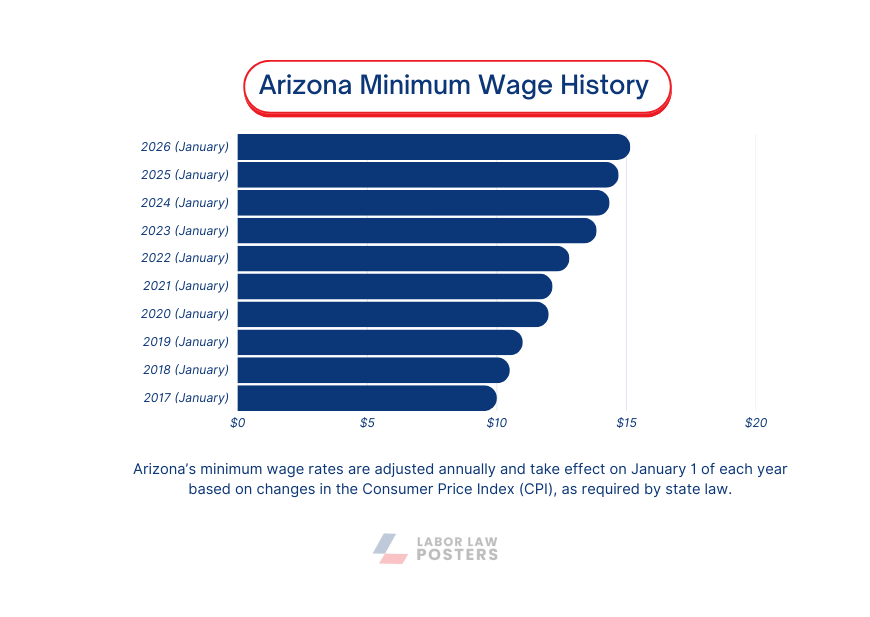
Because Arizona’s minimum wage changes annually based on inflation, employers should also monitor Labor Law Poster Updates to ensure workplace notices remain compliant each year. Employers should also be aware that Arizona law requires up-to-date workplace notices, including minimum wage and earned paid sick time postings, which are covered in the required Arizona Labor Law Posters.
How Arizona Sets Its Minimum Wage
Arizona’s Fair Wages and Healthy Families Act requires the minimum wage to increase every January based on the percentage change in the Consumer Price Index (CPI) for all urban consumers (CPI‑U). The law ensures that wages keep pace with inflation while prohibiting any decrease. Because the calculation uses the August‑to‑August CPI change, increases are typically modest but predictable. The Industrial Commission of Arizona publishes the new rate each September, and employers must begin paying the higher rate on January 1. Employers who fail to pay at least the applicable state or local rate can be liable for unpaid wages plus double damages and civil penalties.
Why Arizona Minimum Wage Exceeds Federal Minimum Wage?
Arizona’s wage law is stricter than federal law. The Fair Labor Standards Act (FLSA) sets a federal minimum wage of $7.25 per hour and allows tipped employers to claim a tip credit of up to $5.12. Arizona’s law supersedes these provisions and requires employers to pay the higher state or local wage. Arizona also mandates that non‑exempt employees receive at least one and one-half times the regular rate at which the person is employed over 40 hours in a workweek, matching the FLSA overtime rule. There is no daily overtime requirement under federal or Arizona law. The table below highlights key differences:
| Category | Arizona (2026) | Federal |
|---|---|---|
| Arizona Minimum Wage | $15.15 per hour | $7.25 per hour |
| Tip Credit | Up to $3.00 per hour | Up to $5.12 per hour |
| Tipped Minimum Cash Wage | $12.15 per hour (before tips) | $2.13 per hour (before tips) |
| Overtime Pay | 1.5× regular rate for hours over 40 in a workweek; no daily overtime | 1.5× regular rate for hours over 40 in a workweek; no daily overtime |
| Enforcement Agency | Industrial Commission of Arizona (ICA) | U.S. Department of Labor, Wage & Hour Division |
City & Local Minimum Wages in Arizona
Cities and counties in Arizona may adopt their own minimum‑wage ordinances so long as they exceed the state rate. Employers operating within city limits should also verify that the City Labor Law Posters requirements are met, as some municipalities require additional notices. At present, Flagstaff and Tucson have enacted higher local rates:
- Flagstaff Minimum Wage (2026)
The Flagstaff city minimum wage is higher than the Arizona State Minimum Wage. Any employer who operates within Flagstaff's city must adhere to Flagstaff's city ordinance and guidelines, even if they are complying with the Arizona State Minimum Wage Law.
- Effective Date: January 1, 2026
- Flagstaff Minimum Wage 2026: $18.35 per hour
- Minimum Wage for Tipped Employees: $18.35 per hour
- Applies to: Applies to individuals working 25 hours or more in a calendar year within city limits.
This wage applies to all employees, as the minimum wage for tipped employees in Flagstaff is the same as that of any other employee in Flagstaff (Hourly, Salary, or Tips).
Why Flagstaff’s Minimum Wage Is Higher Than State Law
- Proposition 414 - “The Minimum Wage Act” was passed during the 2016 general election by voters in Flagstaff.
- The purpose of this local legislation was to provide local workers with a fair wage in Flagstaff.
- Under this law, the city gradually increased wages over several years, reaching $15.00 per hour in 2021. After that point, the wage system shifted to an automatic yearly adjustment.
- In Flagstaff, the minimum wage is adjusted every January 1 based on two factors to ensure that workers are protected against inflation. The two factors are:
- A wage increase based on changes in the Consumer Price Index (CPI), or
- A rate that is $2.00 higher than Arizona’s state minimum wage.
- By using this method, Flagstaff's minimum wage continues to increase over time and will always remain above the statewide minimum wage.
Flagstaff Minimum Wage Over the Years
Year Minimum Wage (per hour) Tipped Minimum Wage (per hour) 2026 $18.35 $18.35 2025 $17.85 $16.85 2024 $17.40 $15.90 2023 $16.80 $14.80 2022 $15.50 $13.00 2021 $15.00 $12.00 2020 $13.00 $10.00 - Tucson Minimum Wage (2026)
The Tucson Minimum Wage Act was passed by voters in Tucson in 2021. This law creates a minimum wage that exceeds both Arizona's state and the federal minimum wage.
The intention of this act is to provide a more accurate representation of what it costs to live in Tucson as compared to other areas, as well as to help workers receive a fair wage for their time.
- Effective Date: January 1, 2026
- Tucson Minimum Wage 2026: $15.45 per hour
- Minimum Wage for Tipped Employees: $12.45 per hour
- Applies to: Employees ( full-time, part-time, or temporary ) who perform at least 5 hours of work per pay cycle within the City of Tucson’s boundaries.
Tipped Employees in Tucson
- A tipped employee is a person who receives $30 or more per week in tips.
- Employers can apply a maximum of $3.00/hour in tip credit and must have total pay (hourly wage plus tips) equal to or greater than the required minimum wage.
Tucson Minimum Wage Over the Years
Year Minimum Wage (per hour) Tipped Minimum Wage (per hour) 2026 $15.45 $12.45 2025 $15.00 $12.00 2024 $14.35 $11.35 2023 $13.85 $10.85 2022 $13.00 $10.00
Which Employers Are Covered by Arizona’s Minimum Wage Law?
Arizona’s minimum wage law applies to almost all employers in the state, with only a few narrow exceptions. The rules are written broadly, so most workers are protected.
| Category | Who is Included |
|---|---|
| Covered Employers |
All employers, such as:
|
| Exempted Employers |
|
Employer Recordkeeping & Payroll Obligations
Under the federal Fair Labor Standards Act, employers in Arizona are required to maintain and track records and notices that employers maintain in their regular business practice. Employers must:
- Post notices: Display a poster in a conspicuous workplace location that informs employees of the current Arizona minimum wage, their right to earned paid sick time, and other protections. For remote workers, provide the poster electronically or link it on the company intranet.
- Provide written information at hire: Give each employee the business name, address, and telephone number.
- Keep payroll records for at least four years: Maintain accurate records showing hours worked each day, wages paid, and earned paid sick time. Failure to maintain records creates a rebuttable presumption of underpayment.
- Permit inspections: Allow the Industrial Commission or law‑enforcement officers to inspect and copy payroll records and to interview employees away from the worksite.
- Allow employee access: Provide employees or their representatives access to their own payroll records.
Employers who violate recordkeeping or posting requirements may be fined at least $250 for a first violation and at least $1,000 for each subsequent or willful violation, as mentioned in Arizona state legislation (A.R.S. § 23-364). Accurate records are also essential for defending against wage claims and audits.
Required Arizona & Federal Labor Law Posters
Apart from Arizona Minimum Wage 2026 Posters, Employers should also post required state, federal, and city labor law posters, which are important to stay compliant with labor laws and to avoid costly fines.
Arizona State Labor Law Posters
- Notice of Workers' Compensation Coverage
- Notice of Unemployment Insurance
- Discrimination Is Prohibited
- OSHA - Safety & Health Protection
- Constructive Discharge Notice
- Minimum Wage
- Notice to Employees-Exposure to Bodily Fluids
- Earned Paid Sick Time
- Smoke Free Notice
- Work Exposure to MRSA
In addition to complying with Arizona law, employers must continue to display all required Federal Labor Law Posters, including minimum wage, FMLA, and EEOC notices.
- EEOC "Know Your Rights" Notice
- Federal Minimum Wage Notice
- Employee Polygraph Protection Notice
- Family and Medical Leave Act Notice (download only where required)
- USERRA Rights and Benefits Notice
- Payday Notice (Meets notification requirements)
- IRS EITC / Notice 797 / W-4 Notice (Meets notification requirements)
- Employee "Right to Know" Notice
- USCIS Discrimination Notice
- E-Verify Right-to-Work Notice
Penalties for Wage Violations in Arizona
Arizona law imposes strict civil penalties on employers who fail to pay required wages or earned paid sick time. These penalties are designed to fully compensate employees and strongly discourage future violations.
| Type of Violation | Penalties |
|---|---|
| Violation related to Recordkeeping or Posting requirements | $250 for a first violation and $1,000 for subsequent or willful violations. |
| Fails to pay the wages or earned paid sick time | Employers must pay the employee the back wages plus an additional equal amount as liquidated damages, including interest. |
Practical Takeaways for Arizona Workers & Employers
For workers, Arizona’s robust wage laws provide strong protection. The state minimum wage climbs annually with inflation and stands at $15.15 per hour in 2026, and local ordinances in Flagstaff ($18.35) and Tucson ($15.45) provide even higher pay. Tipped workers must still receive the full minimum wage once tips are counted, and employers cannot take a tip credit larger than $3. If you suspect underpayment, keep copies of your pay stubs and file a complaint with the Industrial Commission within the applicable time limit. Retaliation for asking about wages or filing a complaint is illegal. For employers, compliance is not optional. Paying at least the state or local minimum wage, tracking tips accurately, paying overtime, and keeping thorough records are essential to avoid fines and lawsuits. Review employee classifications regularly, update labor‑law posters, and stay informed about annual CPI adjustments. Investing in labor law posters and compliance subscriptions may save far more than the cost of potential penalties. When in doubt, seek legal advice; the law encourages a proactive approach and punishes deliberate ignorance.
FAQs
Will Arizona’s minimum wage increase again after 2026?
Yes. The Fair Wages and Healthy Families Act requires the minimum wage to be adjusted each January based on the Consumer Price Index (CPI). Currently, the Arizona minimum wage 2026 is $15.15 per hour, and the Industrial Commission of Arizona will announce the 2027 rate in the fall of 2026.