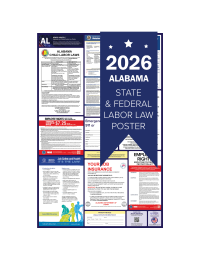


Alabama employers are required to treat their workers fairly and pay them properly. To ensure this, federal and state legislators have passed several laws. Labor law poster compliance service companies, such as Labor Law Posters Online, help employers nationwide meet these requirements. These labor laws are strictly enforced at the federal and state levels by agencies like the Equal Employment Opportunity Commission and the Alabama Department of Labor (ADOL), and the fines for violating them can be substantial. The information included in this post addresses the major elements of Alabama labor laws, answered as frequently asked questions (FAQs).
Who Is Protected by Alabama Employment Laws?
Labor laws in Alabama provide protections for a variety of workers, though they are relatively limited compared to federal regulations. Nevertheless, most of Alabama’s employment laws primarily apply to employees, rather than independent contractors. Misclassified workers, who are treated as independent contractors but are employees, may be entitled to these protections.
What Are Alabama’s Wage Laws?
Alabama does not have a state minimum wage law or an overtime law for adults. As a result, employers subject to the Fair Labor Standards Act (FLSA) are required to pay $7.25 per hour (the federal minimum wage). Tipped employees can be paid a base wage of $2.13 per hour, provided that the combined tips and base wage equal $7.25 per hour. During their first 90 consecutive days of employment, employees under 20 years old may be paid a rate of $4.25 per hour.
What Are the Payment Laws in Alabama?
Alabama has no specific regulations regarding payday schedules for private employees. Employers may choose to pay their workers on a weekly, biweekly, semimonthly, or monthly basis.
What Are Alabama’s Overtime Laws?
As noted, since Alabama does not have its own state minimum wage policy, employers are subject to the requirements under the FLSA. Similarly, Alabama-based businesses must comply with FLSA requirements when it comes to overtime. Under the FLSA, covered employees must receive overtime pay for hours worked more than 40 in a workweek. The overtime pay rate cannot be less than one and a half times their regular rate of pay.
What Are the Required Meal and Rest Break Laws in Alabama?
Alabama does not currently have a law regulating meal breaks or rest periods for adults. For employees aged 14 or 15, employers must give a 30-minute rest period when the employee works more than five hours continuously. However, under the federal FLSA, if an employer provides breaks, those lasting less than 20 minutes are considered work time and must be paid, while breaks lasting 30 minutes or more are generally unpaid.
What Workers’ Compensation Laws Must Alabama Employers Follow?
As enforced by the Alabama Workers’ Compensation Commission, the Alabama Workers’ Compensation Act applies to all employers in Alabama. Employees who suffer injuries or occupational diseases resulting from actions that occurred during their employment may be eligible to receive various types of benefits under the Workers’ Compensation Act.
Under the law, employees are required to report a workplace injury to their employer immediately. Failure to report an injury promptly may result in the denial of benefits. However, employees must make their claim within two years of the accident.
Additionally, the Alabama Workers’ Compensation Act prohibits employers from discharging an employee solely because the employee has sought workers’ compensation benefits. This could be considered an act of retaliation, and companies can be penalized for engaging in such behavior.
What Are the Non-Compete Agreement Laws in Alabama?
Under Alabama employment laws, non-compete agreements are only enforceable if they were completed during the time that the employee was fully employed. Non-competes are unenforceable against independent contractors and individuals considered “professionals.”
Examples of employees who may be subject to non-compete agreements include those with access to trade secrets or confidential information, those with commercial relationships or contacts with specific prospective or existing customers, vendors, patients, or clients, and those who have received specialized and unique training as described in a contract.
What Are the Major Alabama Leave Requirements?
As of the date of this post, Alabama has implemented some leave laws to support employees' health, family responsibilities, and overall well-being. Here's an overview of some of the current requirements:
- Sick or family leave. Employees in Alabama accrue four hours and 20 minutes of sick leave for every semi-monthly work period. Additionally, the Family and Medical Leave Act (FMLA) provides eligible employees with up to 12 work weeks of unpaid leave for birth, serious illness, or care for a family member. FMLA leave, however, only applies to employers with more than 50 employees.
- Voting leave. All Alabama employers must provide registered employees with up to one hour of unpaid leave to vote. However, if polls open two hours before an employee’s shift begins or one hour after their shift ends, the employer may choose not to provide this leave.
- Jury leave. Full-time employees are entitled to paid leave if they are summoned for jury duty. Employers cannot require employees to use annual, vacation, or sick leave to cover their absence. Additionally, businesses cannot terminate employees in retaliation for their jury duty service.
- Victim of crime leave. Alabama employees can take leave to testify in court as a victim or witness of a crime.
- Emergency leave for volunteers. Certified volunteers for the American Red Cross are eligible for 15 days of paid leave in a 12-month period for participating in disaster relief services.
- Military leave. Employees are entitled to up to 168 hours of paid leave per calendar year to fulfill their military service obligations.
Does Alabama Have Child Labor Laws?
Yes. In Alabama, any individual under the age of 19 is considered a minor. Under Alabama’s labor laws for minors, individuals aged 18 are still considered minors with specific legal rights. Minors as young as 14 can be employed in certain occupations in Alabama.
Employers must obtain a Child Labor Certificate for every work location where they employ a minor. For minors aged 14 and 15, a Class I Child Labor Certificate is required. Class II Child Labor Certificates are issued for minors aged 16 to 17. These certificates must be renewed annually and posted publicly.
The hours that minors can work depend on their age and whether they attend school. The law limits the number of hours that minors under 16 may work during school sessions. Minors aged 16 and below may not work during school hours, unless they have graduated or withdrawn from school.
What Are the Hiring Laws in Alabama?
State and federal employment law include elements designed to ensure fair hiring practices. The following are key points of Alabama’s hiring laws:
- New hire reporting. Alabama employers must report all newly hired, rehired, or recalled employees to the Alabama Department of Labor within seven days of their start date.
- Non-discrimination. Employers are prohibited from discriminating against job candidates based on their race, religion, gender, age, disability, sexual orientation, or other protected characteristics.
- Immigration and E-Verify. All employers in Alabama are required to use the federal E-Verify system to confirm the legal work authorization of new hires.
What Are Alabama Termination Laws? Is Alabama an “At-Will” State?
Yes. In Alabama, employment is "at-will," meaning employers can terminate employees for any reason, or no reason, at any time, unless there's a specific law or contract stating otherwise. However, employers cannot fire employees for illegal reasons, such as discrimination or retaliation.
There are no specific Alabama employment laws requiring employers to provide workers with their last paycheck by a particular date; typically, by the next payday is the general rule.
Finally, businesses with 20 or more employees are required to inform terminated workers of their right to continue receiving health insurance under the Consolidated Omnibus Budget Reconciliation Act (COBRA) for 18 to 36 months after termination.
What Are the Occupational Safety Laws Required in Alabama?
Alabama businesses must adhere to federal Occupational Safety and Health Administration (OSHA) standards, as required under the Occupational Safety and Health Act (OSHA Act), which dictate safe working conditions to prevent worker injuries and illnesses.
What Are Some Examples of Mandatory Federal Labor Law Posters and Alabama Labor Law Posters?
Alabama employers are required to display federal and state-specific labor law posters. State of Alabama labor law posters inform employees of their protections and rights. Above all, they must be placed in an easily visible and accessible location, such as break rooms and other communal areas.
Critical Alabama labor law posters that employers may need to display include:
- Workers' Compensation Notice
- Unemployment Insurance
- Child Labor Law
- Partial Unemployment
Required federal labor law posters may include:
- EEOC "Know Your Rights" Notice
- Fed-OSHA "It's the Law" Notice
- Federal Minimum Wage Notice
- Employee Polygraph Protection Notice
- USERRA Rights and Benefits Notice
Employers who fail to display these posters may face fines and penalties. Depending on your city, county, and industry, additional posting requirements may apply. Examples could include postings on Human Trafficking and city ordinances.
Which Federal Labor Laws Must Alabama Employers Follow?
Employers in Alabama are required to follow federal and state labor laws. If an Alabama labor law contradicts a federal labor law, the federal law will take precedence. State lawmakers can pass legislation giving workers additional rights, but cannot remove or diminish rights protected by federal law. Important federal labor laws that Alabama employers should be aware of include:
- Title VII of the 1964 Civil Rights Act (Title VII)
- The Age Discrimination in Employment Act (ADEA)
- The Americans with Disabilities Act (ADA)
- The Fair Labor Standards Act (FLSA)
- The Immigration Reform and Control Act (IRCA)
- The Family Medical and Leave Act (FMLA)
- The Consolidated Omnibus Budget Reconciliation Act (COBRA)
It is important to note that not all federal laws apply to every workplace. Employers should investigate the federal laws, including those listed above, to determine if their business is affected.
What Are Some Recent Updates to Labor Laws in Alabama?
In late 2024 and early 2025, updates were made to Alabama employment laws. Those changes include:
- Income tax exemption. Effective October 1st, 2024, any overtime compensation paid to employees in Alabama will not be included in the employee’s gross income and will be exempt from state income tax deductions. This is effective until June 30th, 2025.
- Child labor law violation penalties. Beginning October 1st, 2024, the fines for violating specific child labor laws increased. Employers now face civil penalties of $300 to $10,000 for the unlawful employment of minors in certain occupations.
Is Alabama a right-to-work state?
Yes, Alabama is a right-to-work state. Employees cannot be required to join a union or pay union dues as a condition of employment.
Is Alabama an at-will employment state?
Yes, Alabama is an at-will employment state. Either the employer or the employee can end the employment relationship at any time, for any lawful reason, subject to anti-discrimination and other legal protections.