



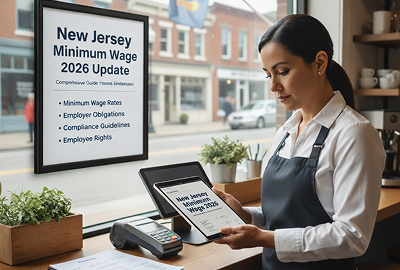
New Jersey business owners generally treat January 1st as a basic administrative checklist. Effective January 1st, 2026, most workers in New Jersey must be paid the minimum wage of $15.92 per hour. But as an employer, if you think you can just update the new $15.92 number into your payroll software, pin a fresh printout to the breakroom, and assume you are compliant for the year, then you are wrong.
Here is where that assumption falls apart: New Jersey enforcement doesn't just look at your base hourly rate. Multi-state retail employers and local franchisees often struggle with the state's aggressive Wage Theft Act, strict seasonal business classifications, and the digital working papers system for minors. If your management team relies strictly on standard federal baselines, you are essentially challenging the New Jersey Department of Labor and Workforce Development (NJDOL) to audit your operations.
This guide simplifies the dense legal jargon. Here is exactly what you need to adjust to stay compliant with the New Jersey minimum wage in 2026 without triggering a back-wage lawsuit. It also reminds employers to display the required New Jersey labor law poster, which must be posted in a visible area at the workplace so employees can easily review their rights and protections under state law.
What Is the Minimum Wage Rate in New Jersey in 2026?
Most businesses in the State of New Jersey must now pay employees a minimum wage of $15.92 per hour. This figure is adjusted annually based on the Consumer Price Index (CPI) to ensure workers' pay keeps up with inflation. Because wage rates change regularly, employers should also review their labor law poster updates to ensure workplace notices reflect the current minimum wage and other required state disclosures.
For almost all workers, the minimum wage rate is $15.92 per hour; however, there are a few specific statutory exceptions for small employers, seasonal operations, and agricultural workers. Under 2019 legislation, phased schedules were established for certain employer categories. Those schedules remain in place in 2026, so the applicable rate depends on workforce size and industry classification.
2026 New Jersey Minimum Wage Rates by Category
The mandatory hourly rates effective January 1st, 2026, are summarized below:
| Employer Category | 2026 Wage Rate Per Hour | Who This Applies To |
|---|---|---|
| Standard Minimum Wage | $15.92 | Most employers have 6 or more employees. |
| Small Employers | $15.23 | Businesses with fewer than 6 employees. |
| Seasonal Employers | $15.23 | Businesses operating only during specific months (e.g., seasonal recreational services). |
| Agricultural Workers | $14.20 | Workers on farms (hourly or piece-rate). |
| Long-term Care (LTC) Staff | $18.92 | Direct care staff in nursing/LTC facilities. |
| Tipped Employees | $6.05 | Cash wage (plus tips) must equal $15.92. |
Industry-Specific Rules
- Small and Seasonal Employers ($15.23 per hour)
Employers with fewer than six employees, as well as qualifying seasonal businesses, aren’t yet required to pay the full standard rate.
While New Jersey's minimum wage is higher overall, small and seasonal employers follow a specific phase-in schedule. For 2026, you must pay at least $15.23 per hour.
Note: “Seasonal employer” is defined by N.J.S.A. 34:11-56a1 as an employer who meets one of the following conditions:
- Exclusively provides services in a continuous period of not more than 10 weeks during June, July, August, and September.
- Receives at least two-thirds of its gross receipts in a continuous 16-week period during the previous calendar year.
- Agricultural Workers ($14.20 per hour)
Agricultural employers follow a longer statutory phase-in schedule extending through 2030. For 2026, the required minimum wage in New Jersey is $14.20 per hour, with additional scheduled increases remaining in effect until parity is reached. The rate covers employees involved in raising or harvesting agricultural or horticultural commodities.
- Long-term Care (LTC) Staff ($18.92 per hour)
Direct care staff in long-term care facilities are subject to a higher minimum wage than the statewide standard. For 2026, this rate is $18.92 per hour.
New Jersey Minimum Wage History
Contrary to the federal minimum wage, which necessitates legislative action by Congress for modification, the Constitution of the State of New Jersey stipulates that annual updates are required. The New Jersey Department of Labor and Workforce Development (NJDOL) determines the adjusted rate by utilizing the Consumer Price Index for Urban Wage Earners and Clerical Workers (CPI-W). An increase in the CPI-W prompts a proportional adjustment in wages.
Although the annual revision offers a degree of predictability, employers are obligated to review the updated rate each year. The forthcoming rate is generally announced in October and becomes effective in the subsequent January.
The following table shows the New Jersey minimum wage history for the past few years at a glance:
| Effective Date | Most Employers (Per Hour Rate) | Small & Seasonal Employers (Per Hour Rate) | Tipped Workers (Cash Wage Per Hour) |
|---|---|---|---|
| January 1st, 2026 | $15.92 | $15.23 | $6.05 |
| January 1st, 2025 | $15.49 | $14.53 | $5.62 |
| January 1st, 2024 | $15.13 | $13.73 | $5.26 |
| January 1st, 2023 | $14.13 | $12.93 | $5.26 |
| January 1st, 2022 | $13.00 | $11.90 | $4.13 |
| January 1st, 2021 | $12.00 | $11.10 | $4.13 |
| January 1st, 2020 | $11.00 | $10.30 | $3.13 |
| July 1, 2019 | $10.00 | $8.85 | $2.63 |
Tipped Employees: Wages and Credit Rules
Effective January 1st, 2026, the minimum wage in New Jersey for tipped employees shall be $6.05 per hour, and employers may claim a tip credit of up to $9.87, provided that total earnings (cash wage plus tips) meet or exceed the minimum wage.
How the Tip Credit Operates
Employers are permitted to apply a tip credit toward their minimum wage obligation. In 2026, the maximum permissible tip credit is $9.87 per hour, which is equivalent to $15.92 minus $6.05.
| Component | Amount Per Hour | Definitions |
|---|---|---|
| Cash Wage | $6.05 | The minimum hourly rate the employer pays directly. |
| Maximum Tip Credit | $9.87 | The amount of tips used to meet the minimum wage requirement. |
| Total Minimum | $15.92 | The mandatory minimum hourly earnings. |
Critical Compliance Rules for Tipped Wages
We’ve seen restaurant managers make incredibly expensive mistakes by misunderstanding the strict rules around the $6.05 cash wage. Here is where teams take weeks during an audit: the make-up requirement. If an employee has a slow week and their tips plus the $6.05 base do not mathematically equal $15.92 per hour, you must pay the difference. Most payroll software defaults to averaging this over a two-week pay period. You cannot do that. The math must be strictly calculated on a 7-day workweek basis.
Then there is tip pooling. Valid tip pools are legally protected, but only for staff who customarily receive tips, such as servers and bartenders. The moment you allow a manager, supervisor, or owner to take a cut of that pool, you invalidate your tip credit entirely. Losing the tip credit means you instantly owe back wages for the full $15.92 rate for every hour worked.
Overtime Rules and Exemption Thresholds
New Jersey doesn’t set its own independent salary threshold for overtime exemptions. Instead, the state strictly adopts the federal standards set by the Fair Labor Standards Act (FLSA).
The 40-Hour Rule
Overtime in New Jersey is calculated on a workweek basis:
- Weekly: Hours > 40 = Overtime (1.5x pay).
- Daily: There is no daily overtime requirement. An employee can work 12 hours in one day without overtime pay, provided their weekly total doesn’t exceed 40 hours.
Salaried Exemptions
Paying a salary doesn’t automatically exempt an employee from overtime. To be exempt, an employee must meet the Salary Basis Test and the Duties Test as outlined by the FLSA.
- Salary Threshold (2026)
New Jersey generally follows the federal overtime exemption rules under the FLSA. To be exempt, an employee must meet both the Salary Basis Test and the Duties Test as defined by federal law.
Note: Federal proposals may raise this rate; employers should always pay the higher of the state or federal threshold.
- Duties Test
The employee’s primary duty must match one of the exempt categories:
- Executive: Responsible for managing the enterprise, supervising two or more full-time employees, and authorized to hire or dismiss staff.
- Administrative: Non-manual roles directly connected to management or business operations, involving discretion on important issues.
- Professional: Positions needing advanced expertise in a scientific or scholarly field, such as doctors, engineers, or lawyers. Note: Giving an employee a managerial title alone does not qualify them for an exemption unless their actual duties meet the legal standards.
In November 2025, a lawsuit was filed against Jersey Tractor Trailer Training, Inc. (JTTT). The company assumed they could classify over 30 CDL driving instructors as independent contractors to dodge standard payroll taxes and overtime. The New Jersey Attorney General and NJDOL did not agree. JTTT was hit with a $345,000 settlement obligation for denying their instructors' rightful wages and failing to maintain basic records. Simply adding a ‘manager’ title to a worker when their actual duties do not meet the legal requirements is the fastest way to trigger a six-figure state lawsuit.
Hiring Minors in 2026: Child Labor Laws
The state has some of the strictest child labor rules in the country, and compliance is now a major operational focus. The transition to a digital compliance system has increased regulatory oversight, and employers should ensure strict adherence to documentation and scheduling requirements.
Working Papers (A300)
The old paper forms are gone. All minors under 18 now need digital working papers via the New Jersey Department of Labor and Workforce Development’s A300 online system. This streamlines the process for schools, employers, and parents.
Work Hour Restrictions
The hours a minor can work depend on their age and whether school is in session.
| Age Group | School Schedule Status | Maximum Work Hours | Prohibited Times |
|---|---|---|---|
| 14- & 15-Years-Old | School weeks |
Maximum 18 hours per week
Maximum 3 hours per day
|
Before 7:00 AM or after 7:00 PM |
| 14- & 15-Years-Old | Non-school weeks (Summer) |
Maximum 40 hours per week
Maximum 8 hours per day
|
Before 7:00 AM or after 7:00 PM (Exception: Can be extended to 9:00 PM only with parents' written permission.) |
| 16- & 17-Years-Old | School weeks |
Maximum 40 hours per week
Maximum 8 hours per day
|
Before 6:00 AM or after 11:00 PM |
| 16- & 17-Years-Old | Non-school weeks (Summer) |
Maximum 50 hours per week
Maximum 10 hours per day
|
Before 6:00 AM or after 11:00 PM (Exception: After 11 PM is allowed in restaurants/seasonal amusements with parent permission.) |
All Minors under 18 must be given a 30-minute meal break after 5 continuous hours of work. This is mandatory and must be documented. Also, minors are generally prohibited from hazardous work, including the use of power-driven machinery (e.g., meat slicers, compactors), construction work, and handling certain chemicals.
Recordkeeping: Essential Details on the Pay Stub
New Jersey is one of the few states requiring specific information on every employee's pay statement. Employers who do not include this mandated information violate state law. Additionally, employers must keep detailed payroll records for at least six years, including hours worked, wage rates, gross pay, deductions, and other key wage and hour data. Time sheets and tax forms should also be retained for a minimum of six years.
Posting Requirements: Visual Compliance
Employers are obliged to display current New Jersey labor law posters prominently in an accessible location where all employees can readily view them. Providing only a single minimum wage poster is insufficient to ensure full visual compliance.
| Required Posting | 2026 Compliance Requirement |
|---|---|
| New Jersey Minimum Wage | Must reflect the updated $15.92 per hour rate. |
| Earned Sick Leave | Outlines employee rights to accrue and use sick time |
| Family Leave Insurance (FLI) | Details the benefits of bonding with a child or caring for a family member |
| Unemployment & Disability | Covers Unemployment and Temporary Disability Benefits |
| Workers' Compensation | Provides information on medical and wage benefits for workplace injuries |
| Whistleblower Protection (CEPA) | Protects employees who report illegal or unethical workplace activity |
| Gender Equity | Explains the right to be free from gender-based pay discrimination |
| Discrimination in Employment | Outlines protections under the NJ Law Against Discrimination (LAD) |
| Employee Misclassification | Details the legal distinctions between employees and contractors |
Quick Tips for Conspicuous Placement
Employers must ensure posters are clearly visible and accessible to employees. In some locations, additional notices may be required under city labor law poster requirements, which should be displayed alongside state and federal posters.
- Common Posting Locations: Most employers choose the break room or a central kitchen area, as these are high-traffic zones for all staff.
- Accessibility: Ensure the posters aren't blocked by furniture or hidden behind a door.
- Remote Workers: If you have a hybrid or remote team, it is a best practice to provide digital copies of these posters via your company intranet or employee handbook.
Simplifying Compliance
Managing multiple posting requirements can be administratively challenging. Employers should ensure all required federal and state notices are current and properly displayed to avoid penalties. A few online labor law poster compliance services offer laminated posters that consolidate all state and federal requirements and share updated ones as soon as a new law is implemented. Additionally, an annual workplace compliance subscription automatically ships updated posters whenever a law changes, ensuring you never face a fine for an outdated notice.
Penalties and the Wage Theft Act
New Jersey’s Wage Theft Act grants substantial enforcement authority and imposes significant penalties for wage violations. It regards unpaid wages not merely as a civil debt but as a severe violation that can lead to criminal sanctions in egregious cases.
Liquidated Damages (200% Penalty)
In instances where an employer fails to pay the correct minimum wage or overtime, the employee may recover:
- The full amount of unpaid wages.
- Liquidated damages of up to 200% of the unpaid wages.
Retaliation Protections
It is unlawful to dismiss, discipline, or threaten an employee for filing a wage complaint. Should an employer take adverse action within 90 days of a complaint, the law presumes retaliation. This presumption significantly shifts the burden of proof onto the employer.
Successor Liability
When acquiring a business, one may also assume its wage liabilities. Under the State’s Wage Theft Act, successor entities can be held accountable for the wage violations committed by the prior owner. Therefore, it is important to conduct thorough due diligence concerning payroll records before the acquisition.
In March 2024, the New Jersey Department of Labor acquired over $2.2 million in back wages for 811 workers deprived of their entitled compensation by Swissport USA Inc. at Newark Airport. The company failed to pay the correct prevailing wage and supplemental health benefits. The State not only mandated the repayment of these wages but also imposed substantial liquidated damages and penalties against the employer.
3 Fatal Employer Mistakes to Avoid in 2026
In practice, the base minimum wage rate is rarely the issue that gets businesses fined. The penalties stem from administrative friction. If you want to survive a New Jersey Department of Labor audit this year, avoid these three specific traps:
- Mismanaging the Seasonal Exemption: A ‘seasonal employer’ is not just a business that gets busy in July. To legally pay the lower $15.23 rate, you must exclusively provide services for no more than 10 continuous weeks during the summer, or receive two-thirds of your gross receipts in a 16-week window. If you keep your boardwalk shop open on weekends through November to clear inventory, you lose that status and owe the full $15.92 rate.
- Ignoring Minor Break Rules: New Jersey digitized all working papers via the A300 system, meaning the state has real-time data on your teen hires. Every minor under 18 absolutely must receive a documented 30-minute meal break after 5 continuous hours of work. If your shift managers let a 17-year-old work 6 hours straight without clocking out for lunch, you are generating a permanent, digital violation.
- Deducting for Uniforms: If you require a specific uniform, you cannot deduct the cost from a worker's paycheck if it drops their effective hourly wage below $15.92. Because most minimum wage workers sit exactly at the statutory limit, any deduction instantly results in a violation. Treat uniforms as a baseline business expense and provide them free of charge.
The most expensive mistake you can make as a business owner right now is assuming your 2025 compliance protocols will protect you this year. The NJDOL does not issue polite warnings for missing signage or outdated breakroom posters; they issue compounding fines per location, per day.
You need to make a definitive choice about how you handle labor law updates. You can either assign an HR manager to work for weeks manually tracking state, federal, and local legislative shifts, or you can completely automate the risk.
It is highly recommended to rely on annual workplace compliance plans. This ensures that the exact, fully compliant laminated New Jersey minimum wage posters alongside your mandatory federal labor law posters are automatically shipped to your locations the moment a law changes.
Stop leaving your compliance to chance. Get your breakrooms audit-ready today.
FAQs
Did the New Jersey minimum wage increase in 2026?
Yes. Effective January 1st, 2026, the standard statewide minimum wage for New Jersey increased to $15.92 per hour for most employees. This adjustment is mandated by the New Jersey State Constitution, which requires the Department of Labor and Workforce Development (NJDOL) to adjust the rate annually based on the Consumer Price Index for Urban Wage Earners and Clerical Workers (CPI-W).