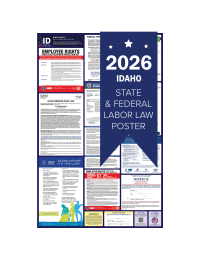



Just like all employers in the United States, Idaho businesses are required to treat workers fairly. To ensure this, several laws have been passed by federal and Idaho state legislators. Labor Law Compliance Service companies, such as Labor Law Posters Online, help employers nationwide to meet these requirements. These labor laws are strictly enforced at the federal and state levels by agencies like the Equal Employment Opportunity Commission and the Idaho Department of Labor. If an employee fails to comply with state and federal employment laws can result in heavy fines and penalties. The information included in this post addresses the major elements of Idaho labor laws, answered as frequently asked questions (FAQs).
Who Is Protected by Idaho Employment Laws?
Idaho labor laws protect many workers, but the protections are not as extensive as those provided by the federal government. Further, it is key to emphasize that most of Idaho’s employment laws only protect employees (not independent contractors).
What Are Idaho’s Wage Laws?
Idaho does not have a state minimum wage law or an overtime law for adults. As a result, employers subject to the Fair Labor Standards Act (FLSA) are required to pay the federal minimum wage of $7.25 per hour. Posting the updated Idaho minimum wage poster is an important step in keeping employees informed about these requirements and ensuring compliance. Employees who earn more than $30 in tips are classified as ‘tipped employees’ in Idaho. Employers can pay tipped employees a reduced cash wage of $3.35 per hour, with a tip credit of $3.90. Notably, a tipped employee’s hourly cash wages and earned tips should amount to the state-mandated minimum wage. If not, the employer is required to make up the difference.
What Are the Payment Laws in Idaho?
In Idaho, employees must be paid at least once in a calendar month. Businesses must decide on the payday when the employee is hired, but it should be set within 15 days after the employee’s pay period ends. If a payday falls on a holiday or non-workday, the wages must be paid on the preceding workday.
What Are Idaho’s Overtime Laws?
Since Idaho does not have its own state minimum wage policy, employers need to follow the requirements under the FLSA. Similarly, companies that are located in Idaho must comply with the FLSA rules regarding overtime. The FLSA requires that covered employees receive overtime pay for any hours worked in excess of 40 hours in a workweek. The overtime pay rate cannot be less than one and a half times their regular rate of pay.
What Are the Required Meal and Rest Break Laws in Idaho?
Idaho does not have a law regulating meal breaks or rest periods for adults right now. However, under the federal FLSA, if an employer provides breaks that last for less than 20 minutes are considered work time and it must be paid, while breaks lasting 30 minutes or more are generally unpaid.
What Workers’ Compensation Laws Must Idaho Employers Follow?
Employers with one or more full-time, part-time, seasonal or occasional employees must have workers’ compensation coverage under the Idaho Workers’ Compensation Law. An employer must obtain this coverage before the first employee is hired.
If an employee gets injured, and the employer did not have coverage of workers’ compensation insurance at the time of the injury, the employer may be liable for all benefits, medical expenses, and lost wages resulting from the injury in accordance with the Idaho Workers’ Compensation Law. In addition to all benefits, the uninsured employer may also incur penalties of 10% of the wage loss and medical benefits in the workers’ compensation claim and any attorney fees if there is representation by an attorney for the injured party.
Workers’ Compensation Act can be charged a fine of $2.00 per day per employee, or $25.00 per day maximum, based on the greater amount. The Workers’ Compensation Act also grants the Industrial Commission the power to seek an injunction against the employer to prohibit the employer from conducting the business in violation of the Workers’ Compensation Act.
An employer conducting a business without coverage under the Workers’ Compensation Act can be held liable for a violation of the Workers’ Compensation Act.
What Are the Non-Compete Agreement Laws in Idaho?
Under Idaho employment laws, non-compete agreements are only enforceable if they:
- Do not impose a greater restraint on the employee than necessary.
- Protect a legitimate business interest, such as trade secrets or client relationships.
- Are reasonable in geographic scope—the area covered by the non-compete must be tied to the region where the business operates or where the employee had a direct impact.
- Are reasonable in duration.
In Idaho, non-compete agreements typically cannot exceed 18 months, unless exceptional circumstances apply.
Examples of employees who may be subject to non-compete agreements include those with access to trade secrets or confidential information, those with commercial relationships or contacts with specific prospective or existing customers, vendors, patients, or clients, and those who have received specialized and unique training as described in a contract.
What Are the Major Leave Requirements in Idaho?
As of the date of this post, Idaho has established some leave laws to assist employees in attending to their own health, family obligations, and general well-being. The following is a brief overview of some of the current state leave requirements:
- Sick leave. Employees in Idaho will earn sick leave at the rate of 0.04615 hours for each hour worked. Employees scheduled for fewer than 20 work hours per week, who have been employed for less than 5 months, or are in unpaid status, are not eligible to accrue sick leave. Sick leave may be used for the employee’s own illness or medical appointment, a family member’s illness or medical appointment, or for bereavement.
- Jury leave. Idaho law prohibits employers from firing or discriminating against an employee who is summoned for jury service. Since jury service is unpaid leave, so if an employer who violates this law may be liable for a fine of $300.
- Military leave. Employees are entitled to up to 15 days of paid leave within a one-year period for military service.
Does Idaho Have Child Labor Laws?
Yes. In Idaho, minors under the age of 16 are not allowed to work during school hours unless the minor can read and write basic English and can understand geography and foundational math, including fractions.
Idaho considers any individual under the age of 18 a minor. However, a minor can be considered an adult (emancipated) if they are married or if emancipation is granted by law. The minimum age of employment in Idaho is 14.
State law does not require work permits for minors employed in Idaho. However, employers are required to maintain accurate employment records for all minors aged 14 to 16.
What Are the Hiring Laws in Idaho?
According to the Idaho Human Rights Act, if an employer has five or more employees, they cannot discriminate their employees based on race, color, sex, national origin, ethnic origin, age, disability, religion, or pregnancy.
Is Idaho a “Right-to-Work” State?
Yes, Idaho is a right-to-work state, meaning that any working employee cannot be required to join or pay dues to a labor union as a condition of employment.
What Are Idaho Termination Laws? Is Idaho an “At-Will” State?
Yes. Idaho is an "At-Will" state, which means employers can terminate employees for any reason, or no reason, at any time, unless there is a specific law or contract stating this. However, employers cannot fire employees for reasons which are illegal, such as discrimination or retaliation.
After a layoff or termination, an employee must receive their final paycheck within 10 business days (excluding weekends and holidays). The process can be completed within 48 hours (excluding weekends and holidays) if the employee submits a written request.
Employees who do not receive hourly or salary pay must receive due pay for all hours worked in the pay period prior to their final employment date, unless exempt from minimum wage laws under Idaho labor law. Other pay, including bonuses and commissions, may be paid on the next payday that is scheduled.
What Are the Occupational Safety Laws Required in Idaho?
Idaho businesses must adhere to federal Occupational Safety and Health Administration (OSHA) standards, as required under the Occupational Safety and Health Act (OSHA Act), which dictate safe working conditions to prevent worker injuries and illnesses.
What Are Some Examples of Mandatory Federal Labor Law Posters and Idaho Labor Law Posters
In Idaho, employers must display labor law posters provided by both the federal government and the state of Idaho. Idaho labor law posters are designed to inform employees about their rights and protections. In any case, the specific labor law poster must be displayed in a conspicuous and accessible location, such as break rooms or other common areas.
Important posters to consider displaying for Idaho Labor Law Posters are:
- Workers' Compensation Sample
- Unemployment Insurance
- Discrimination
- Minimum Wage
- Equal Opportunity is the Law
Required federal labor law posters may include:
- EEOC "Know Your Rights" Notice
- Fed-OSHA "It's the Law" Notice
- Federal Minimum Wage Notice
- Employee Polygraph Protection Notice
- USERRA Rights and Benefits Notice
Employers who fail to display these posters may face fines and penalties. Depending on your city, county, and industry, additional posting requirements may apply. Examples could include postings on Human Trafficking and city ordinances.
Which Federal Labor Laws Must Idaho Employers Follow?
Employers in Idaho are required to follow federal and state labor laws. If an Idaho labor law contradicts a federal labor law, the federal law must take precedence. State lawmakers can pass legislation giving workers additional rights, but cannot remove or diminish rights protected by federal law. Important federal labor laws that Idaho employers should be aware of include:
- Title VII of the 1964 Civil Rights Act (Title VII)
- The Age Discrimination in Employment Act (ADEA)
- The Americans with Disabilities Act (ADA)
- The Fair Labor Standards Act (FLSA)
- The Immigration Reform and Control Act (IRCA)
- The Family Medical and Leave Act (FMLA)
- The Consolidated Omnibus Budget Reconciliation Act (COBRA)
It is important to note that not all federal laws apply to every workplace. Employers should investigate the federal laws, including those listed above, to determine if their business is affected.
Quick Compliance Checklist for Idaho Employers
In the absence of the state of Idaho passing significant labor and employment laws in 2025, employers can use the following list to verify that they are showing good-faith compliance with current Idaho employment laws:
- Are you paying at least the required federal minimum wage of $7.25 per hour?
- Are you following federal Fair Labor Standards Act (FLSA) overtime and break time requirements?
- Are you providing final paychecks in accordance with Idaho law?
- Are you respecting Idaho’s child labor laws, if applicable?
- Are you complying with federal Occupational Safety and Health (OSH) Act regulations?
- Do you grant leave time to employees as required under Idaho state laws?
Is Idaho a right-to-work state?
Yes, Idaho is a right-to-work state. Employees cannot be required to join a union or pay union dues as a condition of employment.
Is Idaho an at-will employment state?
Yes, Idaho is an at-will employment state. Either the employer or the employee can end the employment relationship at any time, for any lawful reason, subject to anti-discrimination and other legal protections.
Related state guides: Ohio labor laws guide and Labor Laws in Alabama.