



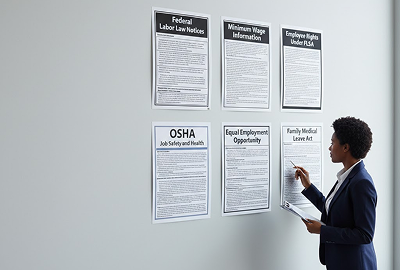
Many HR managers assume that buying a laminated labor law poster once a year solves their compliance problem. It doesn't. We’ve seen multi-state retail employers rely on outdated signage in their breakrooms, only to trigger massive fines during a routine Department of Labor (DOL) audit. Labor law compliance is not a set-it-and-forget-it administrative task. It is a mandatory communication channel strictly enforced by federal, state, and local agencies.
When a new regulation passes, a minimum wage rate shifts, or an agency updates a mandatory notice, that static poster becomes a liability. Missing a single labor law poster update can lead to steep financial penalties, escalated legal headaches, and fundamentally damage your defense in employment lawsuits.
This guide breaks down exactly what you must post, where most businesses fail, and how to bulletproof your workplace compliance strategy in 2026.
Why Labor Law Poster Compliance Matters for Employers
Imagine a federal auditor walking into your workplace and reviewing your compliance materials. The very first thing they check before looking at a single payroll record is your breakroom wall. If you are missing required notices, the audit instantly escalates.
These labor law posters are government-mandated notices designed to guarantee information equity. They ensure every employee has visible access to their legal protections regarding safety, pay, and discrimination.
Why Are They Legally Required?
Agencies such as the U.S. Department of Labor (DOL) and the Occupational Safety and Health Administration (OSHA) mandate these postings to promote transparency. These notices ensure that all employees, irrespective of their position or duration of employment, have unobstructed access to information regarding their legal protections. According to the DOL, these posters are intended to inform employees of their rights concerning compensation, workplace safety, and protections against discrimination.
The Risks Of Missing Or Outdated Posters
State & federal fines for poster non-compliance are severe and often indexed for inflation.
- A single OSHA posting violation can cost employers over $16,000.
- Failing to display the Employee Polygraph Protection Act (EPPA) poster can result in fines of over $26,000 per violation.
- Beyond fines, missing posters can damage your defense in employment lawsuits. If an employee claims they weren’t aware of their rights, your empty wall becomes evidence of negligence.
Who Must Comply With Labor Law Posting Requirements:
- Employers & Business Owners: To protect the bottom line.
- HR Teams: To maintain operational compliance.
- Compliance Managers: To navigate multi-state complexities, dedicated labor and compliance services consolidate every requirement into a single subscription.
Most advice skips this one critical problem: the empty wall defense. In practice, missing posters do more than just trigger federal fines; they destroy your defense in wrongful termination or wage lawsuits. If an employee claims they weren't aware of their rights, your lack of a labor law poster serves as direct evidence of negligence.
What Are Labor Law Poster Requirements?
Labor law posting requirements are statutory obligations that require employers to display official notices in conspicuous places where employees can easily read them. These are not general HR memos; they are standardized documents issued by government agencies.
Purpose of Workplace Postings
The goal of displaying a labor law poster is simple: information equity. Whether a worker is a seasoned manager or a new hire, they must have equal access to information about:
- Minimum wage rates
- Workplace safety protocols
- Anti-discrimination laws
- Workers' compensation procedures
- Family and medical leave rights
Who Enforces Poster Compliance?
Enforcement is divided among several agencies, creating a layer of compliance:
- Federal: The U.S. Department of Labor (DOL), the Equal Employment Opportunity Commission (EEOC), and the Occupational Safety and Health Administration (OSHA).
- State: State-Specific Labor Departments, Human Rights Commissions, and Workers' Compensation Boards.
- Local/City Labor Laws: City councils and local workforce agencies (increasingly common for minimum wage and paid sick leave requirements).
The Differences Between Labor Law Posters and General HR Policies
It is crucial to distinguish between mandatory labor law posters and internal HR policies, as they serve different legal functions.
- Labor Law Posters: Labor law posters are official notices issued by government agencies that employers are required to display in the workplace. Employers must post these notices exactly as provided and are not allowed to alter, edit, or summarize their content.
- HR Policies: These include both contractual and internal policies. They include your specific company handbook, dress code, remote work policies, or PTO accrual rates. The employer creates these and does not replace the required labor law posters.
Which Employers Must Comply?
Compliance is not solely designated for large corporations; workplace compliance obligations extend to employers of all sizes. Not sure the rules apply to you? See our compliance guide for U.S. employers. If you maintain one or more employees on payroll, it is generally required to prominently display a mandatory labor law poster.
- Private Sector Employers: Nearly all private enterprises employing at least one individual are mandated to publish federal notices, including those mandated under the Fair Labor Standards Act (FLSA) and regulations established and monitored by OSHA. Certain federal posters are applicable only if the employer meets specific coverage criteria.
- Public Sector Employers: Federal, state, and local governmental agencies are subject to their own specific requirements, which vary slightly from those applicable to the private sector.
- OSHA: Generally, Federal OSHA coverage does not extend to public sector employees. Nevertheless, if the state operates an OSHA-approved State Plan, public sector employers are required to display the relevant state-specific OSHA poster.
- FLSA: Public sector employers at the state and local government levels are typically obligated to adhere to FLSA posting requirements concerning minimum wage and overtime regulations.
- Whistleblower Rights: Employers in the public sector often have distinct posting requirements related to whistleblower protections that differ from those applicable to private sector employers.
- Small Businesses & Startups
Small businesses are still required to follow labor law posting rules. For instance, even if you have only one employee, you must display the FLSA and EPPA posters. Startups working in co-working spaces need to make sure their employees can see these notices, whether in their private office or on a shared wall, as long as the placement complies with regulations.
- Nonprofits
Nonprofit organizations are required to adhere to labor laws similar to for-profit companies. They must follow the same federal and state posting requirements, which include notices on minimum wage, anti-discrimination policies, and polygraph protections.
- Multi-State and Multi-Location Employers
This is where compliance becomes intricate. You are required to display the specific posters for each physical location. For instance, if you have an office in New York and a warehouse in Texas, the New York office must display New York-specific labor law posters, and the Texas warehouse must display Texas labor law posters. It is not permissible to simply post the laws of the state where the company is headquartered at all satellite locations.
Federal Labor Law Poster Requirements for Employers
Federal requirements are the baseline that applies nationwide. However, which federal labor law posters an employer must display depends on whether specific laws apply to the business. These posters are generally free to download from the DOL website, though many employers prefer the All-On-One state and federal labor law poster, which comes in laminated versions to save space and ensure durability.
Common Federal Posters Employers Must Display
- Fair Labor Standards Act (FLSA)
- Agency: DOL (Wage and Hour Division)
- Purpose: Outlines the federal minimum wage ($7.25/hr), overtime rules, and child labor laws.
- Critical Update: Recent revisions include the PUMP Act, which requires employers to grant nursing mothers reasonable breaks and private spaces for pumping breast milk. If your FLSA poster was published before April 2023, it probably does not meet compliance standards.
- Penalty: Fines for specific FLSA child labor infractions can surpass $16,035 per employee, with higher penalties for violations resulting in injury.
- Job Safety and Health: It’s the Law (OSHA)
- Agency: Occupational Safety and Health Administration (OSHA)
- Purpose: Educates workers about their right to a safe workplace and how to report hazards anonymously.
- Requirement: Must be posted prominently where employees can easily see it.
- Penalty: Fines up to $16,550 per violation (adjusted annually for inflation).
- Know Your Rights: Workplace Discrimination is Illegal
- Agency: Equal Employment Opportunity Commission (EEOC)
- Purpose: Provides protections against discrimination based on race, color, religion, sex (including pregnancy), and disability.
- Critical Update: This poster was substantially revised in June 2023 to include the Pregnant Workers Fairness Act (PWFA). Displaying the latest version is crucial for preventing discrimination claims.
- Penalty: Up to $698 per violation.
- Family and Medical Leave Act (FMLA)
- Agency: Department of Labor (DOL)
- Who Must Post: Public agencies and private employers with 50 or more employees.
- Purpose: Explains employees' right to unpaid, job-protected leave for family and medical reasons, including military family leave.
- Penalty: Up to $216 per violation.
- Employee Polygraph Protection Act (EPPA)
- Agency: DOL
- Purpose: Bans most private employers from using lie detector tests during pre-employment screening.
- Penalty: Up to $26,262 (one of the highest penalties for non-posting).
- Note: This poster is often overlooked because employers assume it doesn't apply unless they use polygraphs. However, almost all private employers are required to post it.
- Uniformed Services Employment and Reemployment Rights Act (USERRA)
- Agency: DOL/Veterans’ Employment and Training Service (VETS)
- Purpose: Details the rights of military members to return to their civilian jobs after service.
Language and Accessibility
If a large part of your workforce does not speak English, you are usually required to display these notices in their main language (for example, Spanish). Not doing so may be seen as a failure to post.
State Labor Law Poster Requirements
While federal laws set the floor for posting requirements, states often set the ceiling. State posters are frequently more generous to employees in terms of their workplace rights than federal ones. For that reason, you must post both.
How State Posting Requirements Differ
States often have higher minimum wages, stricter safety laws, or broader anti-discrimination protections. For a breakdown by state, see our state-by-state poster requirements list. For example, while the federal minimum wage is $7.25, states like California, New York, and Washington have rates more than double that. You must display the poster that matches the law applicable to your specific location.
Examples of State-Specific Required Posters For The Workplace
- State Minimum Wage: Often updated annually on January 1st or July 1st.
- Unemployment Insurance: Provides details on how to file claims through the state workforce commission.
- Workers' Compensation: Usually includes the name of your specific insurance carrier and workplace policy number.
- Paid Sick Leave: States like Colorado, New Jersey, and Oregon have specific paid leave mandates with their own required notices.
- No Smoking: Many states require specific signage regarding smoking distances from entrances.
- Whistleblower Protections: Many states carry specific laws that protect employees who report unsafe and illegal activities.
Managing Compliance Across Multiple States
If you have offices in Texas and California, the breakroom walls will look different. The Texas office needs Texas-specific posters; the California office needs California-specific labor law posters. You cannot use a generic national poster for state compliance.
- Example: The Illinois Department of Labor requires specific posters regarding "Pregnancy Rights in the Workplace" that are distinct from federal requirements.
- Example: The Kansas Department of Labor mandates notices regarding child labor that are specific to state statutes.
Local and City Labor Law: What Posters Are Required In The Workplace?
This is where many employers encounter difficulties. Municipalities and counties have increasingly entered the realm of employment law.
Why local notices are frequently neglected: Employers presume that compliance with state regulations suffices. However, cities such as San Francisco, Seattle, Chicago, and New York City enforce their own stringent ordinances.
Examples of Local Labor Law Posting Requirements include:
- City Minimum Wage: Often surpassing the state minimum wage.
- Fair Work Week: Regulations concerning scheduling predictability in retail and food service sectors.
- Paid Sick Time: Local mandates that exceed state standards for accrual and usage.
- Gender-Neutral Restrooms: Signage requirements for single-stall facilities.
If your enterprise operates within city boundaries that have these ordinances, neglecting to display the specific city notices constitutes a violation.
The Remote Work Necessity: Posting for Hybrid Teams
The rise of remote work has complicated the definition of a conspicuous place to hang required labor law posters. If an employee never enters the company’s breakroom, how do you comply?
The Department of Labor's Guidance
The DOL issued Field Assistance Bulletin No. 2020-7, which clarified that electronic posting can satisfy requirements under certain conditions.
- Continuous Access: The notices must be available at all times (e.g., on an internal intranet or HR portal), not just emailed once during onboarding.
- Easy Access: Employees must be able to view the posters without asking for permission or using a password they don't normally use.
- Hybrid Workplace: If you have a hybrid workforce (some in office, some remote), you must have both physical posters in the office and electronic postings for remote workers. Compare the two in our digital vs physical posters guide. You cannot rely solely on electronic postings if you have a physical workplace.
How Employers Can Stay Compliant With Labor Law Poster Requirements
Keeping up with federal, state, and city changes manually is a full-time job. Here is how to streamline it.
- Conducting Poster Compliance Audits
Walk through your facilities once a quarter and ask yourself the following:
- Are the posters visible and not behind a door, any machinery, or a coat rack?
- Are they physically damaged, torn, or faded?
Also, check the revision dates at the bottom of the posters against the latest government releases. If your OSHA poster is from 2014, it is non-compliant.
- Using All-On-One Federal and State Poster Solutions
Using separate labor law posters is time-consuming and often leads to non-compliance if the employer fails to post required notices. Many employers use our Annual Workplace Compliance Subscriptions, which offer automatic updates whenever there is a change in labor laws and an update to a required poster. Our All-On-One Posters combine all mandatory federal and state notices into a single, laminated sheet. This helps save space and ensures you haven't accidentally missed one specific notice (like the EPPA).
- Managing Compliance for Multi-State Teams
Centralize your tracking. Maintain a spreadsheet of all physical locations and the corresponding "poster sets" required for each. When a state updates its minimum wage (which usually happens either January 1st or July 1st), you know exactly what posters are required in which workplace.
- Automating Updates and Replacements
Laws change frequently. Subscription services, like the one offered by Labor Law Posters Online, can automatically ship you a new poster whenever a mandatory update occurs, removing the need for you to constantly monitor government websites.
Staying Compliant Is Easier Than Fixing Violations
Labor law poster updates are a non-negotiable part of doing business. While they may seem like administrative clutter, they serve a vital legal function, protecting your business from fines and ensuring your employees are informed.
The cost of a compliance poster is a tiny fraction of what you would pay for a government fine. Don't wait for an inspector to identify your blind spots. Check your breakrooms today, update your digital portals, and set up an automated subscription service. A small investment in labor law poster compliance service now ensures you won't be paying the government later.
FAQs
What posters need to be posted in the workplace?
Most U.S. employers must display federal, state, and sometimes local labor law posters in a conspicuous location. Our federal labor law poster consolidates every mandatory federal notice into a single display. Common required posters for the workplace include the Fair Labor Standards Act (minimum wage and overtime) poster, the OSHA: It’s the Law safety notice, the EEOC’s Know Your Rights poster, an FMLA notice (if applicable), and the Employee Polygraph Protection Act poster. State and city laws may also require additional posters, such as minimum wage, paid sick leave, and workers’ compensation notices.